Generations of Bodles residents uprooted
Article By: Alexia King-Whyte
-

- Sep 24, 2025 07:54 AM | News
-
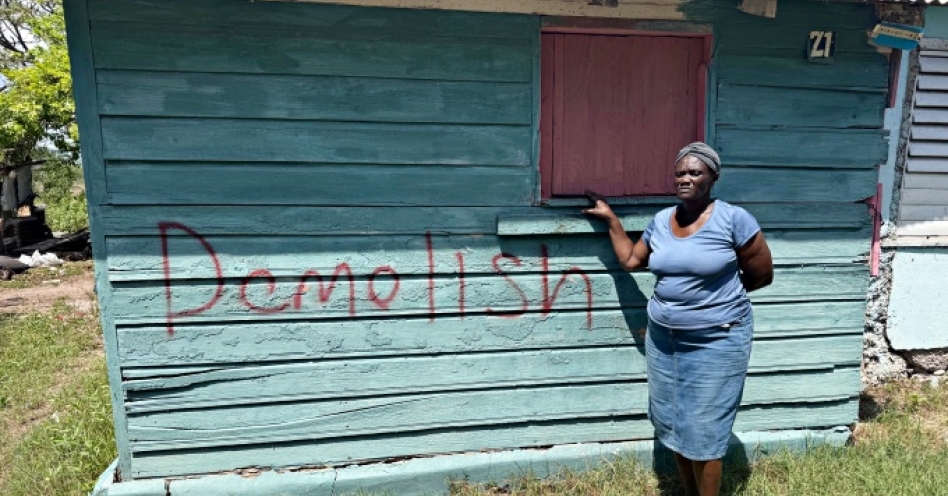
Among those affected is 61-year-old Indiana Prince Johnson, who says she was born on the property and raised by parents who both worked at the Bodles Research Station.
The demolition works began last week in an area called Dairy where five very antique houses made of brick and wood, were destroyed to make way for a long-delayed government project lagging in the pipeline for many years now.
While the occupiers are not resistant to the changes afoot, for some residents, the action represents the end of decades of life at the property. However, for the Ministry of Agriculture, Fisheries and Mining, it is a long-delayed step toward restoring the station to its intended purpose.
Among those affected is 61-year-old Indiana Prince Johnson, who says she has nowhere else to go. Johnson claims she was born on the property and raised by parents who both worked at the station before their passing. She said she has lived there most of her life, raising her three children in the same home, though she left for a period before returning about seven years ago. Since then, her daughter and grandchildren have also lived there, continuing a family presence that spans decades.
Johnson describes her family’s situation as desperate.
“The buildings are really old, and I’m not really saying that I want to stay here, but I really need help” she explained. “I was planning to move last night like one of my neighbour, but because I didn't have enough money, the truck man forfeit and don't come. And moreover, where I'm planning to go can’t even hold us.”
Johnson had yet to secure a suitable housing and said her only option is a small one-room structure without a bathroom, far too cramped for her daughter and grandchildren to live.
“My problem is really to add on another room and to build a bathroom,” she said, adding that she had managed to secure some building material and small donations from her church family — not nearly enough to cover the total construction expense.
Because of the crisis, Johnson’s three granddaughters were sent to live temporarily with their 23-year-old aunt.
Her case is not unique. Another family who operated a small grocery shop on the property has also been displaced. The shop became the household’s only source of income following the breadwinner’s retirement from the ministry. Their home was the first to be demolished, forcing the family to relocate overnight.
Another resident, Dennis Washington, told Old Harbour News that he had received no notice before his home was targeted for demolition. Washington, who once worked at the station but has since left, said he was shocked when he saw men spray painting ‘demolish’ on the house.
“I live here years now and I can’t believe this. All my children were born and raised on this farm. I have no other home…I am waiting on my daughter to come for me with her baby father,” he said.
According to Johnson, only she and one other resident were formally served with a notice of removal dated February 12, 2025, giving them 30 days to vacate. The other resident declined to speak publicly. In total, six houses stood on the property; five have been earmarked for demolition, while the sixth remains standing — for now — because its occupant, Johnson’s brother, is still employed by the ministry.
The Ministry of Agriculture, Fisheries and Mining, however, maintains that all residents had ample time to prepare. According to Ashraf Muqtadir, from the Ministry’s Security, Energy & Emergency Management Department, notices were first given years ago.
“They have been getting notice from about three years ago, the letter in February was the final warning,” said Muqtadir. “That specific area is actually earmarked for farming projects and these projects are being held up for far too long.”
Muqtadir added that the ministry gave residents an extended period — “at least 300 days” from the February notice until now — before taking action. He insisted that Johnson and others had no legal right to remain on the premises designated as a research station, not a residential area.
“It’s not a recent thing. They were warned, both in writing and verbally… constant communication,” he said. “As a matter of fact, they should have been removed years ago. But we tried not to take a hard line. Now the projects must move forward.”
According to the representative, the ministry has revealed plans to repurpose the land for agricultural projects while constructing new housing for staff in another section of the property. Those accommodations will be reserved for current employees.
Still, for Johnson, the sense of displacement is overwhelming. What began as a family home inherited through generations has ended in uncertainty.
“I was born here, my parents lived and died here, I raised my children here, and now I don’t know where to go,” she said softly, watching as workers dismantled the wooden frame of her childhood home.
The demolitions highlight a wider tension between state development plans and the people who have, for decades, built lives on government-owned land. While the ministry maintains its legal right to enforce removal after serving notice, Johnson and her family, along with other families, are left struggling to secure suitable housing. She is appealing for assistance and can be contacted at (876) 509-4753.