Old Harbour group champions St. Elizabeth recovery
Article By: Alexia King-Whyte
-

- Dec 12, 2025 07:43 AM | News
-
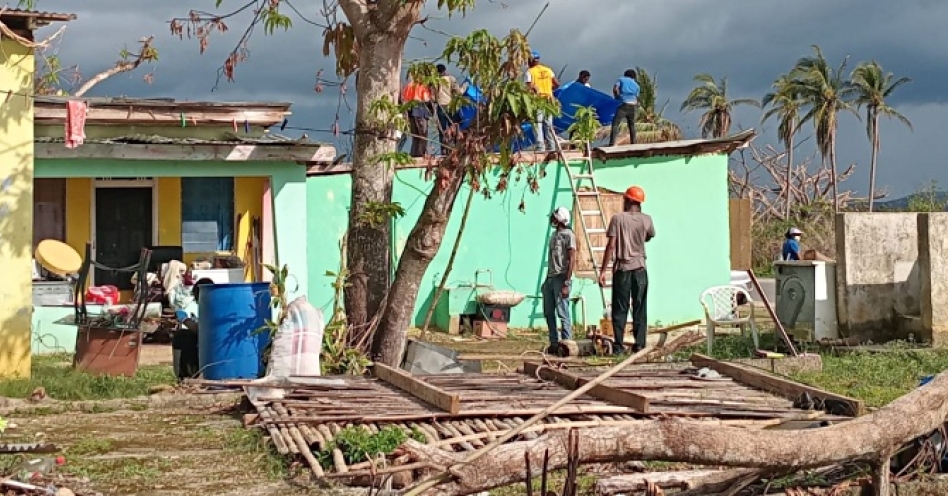
Finnikin and Phase One Global team working in St Elizabeth.
Led by community development specialist, social activist and volunteer coordinator, Randy Finnikin, a volunteer team has completed three humanitarian missions in Black River, Middle Quarters, and at Munro College — bringing manpower, construction skills, supplies, and renewed spirit to residents who felt they had nowhere else to turn.
The effort began after a heartfelt radio appeal from the communications officer of the Middle Quarters Community Development Committee (CDC). While the community is widely known as a roadside stop famous for peppered shrimp, Finnikin, who is also chairman of the Sunbeam Boy’s Home and head of Minister’s Fraternal, said the caller reminded the public that Middle Quarters is, at its core, a farming community, and families there had suffered overwhelming losses, from shattered roofs to destroyed livelihoods.
Her plea, he said, struck him deeply.
“I was touched by her eloquence and the uniqueness of her appeal,” Finnikin recounted in an interview with Old Harbour News. “She wasn’t asking for food. She asked for carpenters, electricians — anybody who could help rebuild whether voluntarily or can offer their skill for pay. That spoke directly to my heart as a social engineer and a missionary to the Old Harbour community. I thought her analysis and strategy for attracting help was worthy.”
With his long-standing involvement in the Old Harbour CDC, Finnikin proposed a partnership: a mission to mobilize volunteers, artisans, and resources to support a “sister CDC” in its time of crisis. What started as an idea quickly evolved into a community-wide initiative endorsed by local civic groups.
The first mission took Finnikin and a Jamaica Urban Transit Company (JUTC) bus full of volunteers, supplies, food and clothes into Black River, where damage was widespread and residents were struggling to restore normalcy.
Using what Finnikin describes as a “boots-on-the-ground, stop-and-serve” strategy, the team drove through affected districts, halting wherever they saw someone attempting repairs.
“We saw people on their roofs trying to fix what the hurricane had taken and they couldn’t manage,” he said. “We simply stopped the bus and said, ‘Hey, can we help you?’ The rest was history.”
By the end of the day, the team had repaired four damaged roofs, removed debris, and cleaned mud-filled homes for residents who said they had reached breaking point.
One encounter stood out: a veteran educator with 30 years of service, who had lost almost everything. Earlier that morning, she told the team, she had given up hope.
“She thought we were tourists looking at the destruction… but when we stopped and offered help, she said, ‘God answered my prayer’. They were all grateful for our help,” Finnikin said.
The second mission brought similar results but was challenged by heavy afternoon rain. Still, volunteers managed to repair two roofs, distribute supplies, and clear debris from several farm-based properties. The operation also supported residents in restarting their livelihoods, including a CDC public relations officer whose plant nursery had been smothered by debris.
“Yes, you need food to survive” Finnikin explained, “but you also need shelter — and beyond that, you need a livelihood. We focused on all three. We found that the devastation has a negative impact on the well-being of persons so we had to step up in this particular way.”
Additionally, a mission was conducted at Munro College in Potsdam. Through Finnikin’s partnership with Phase One Global, an organization using basketball as a pathway to scholarships and athletic careers, the team assisted young athletes whose dorm facilities had been severely affected.
The volunteers rebuilt beds, repaired facilities, and cleared mud and debris — making the dorms livable again for the male and female athletes in the academy. When their team arrived, Finnikin said their host greeted them by announcing to the students: “Calvery has arrived. Help is here”
Across all missions, the volunteer group included skilled and unskilled individuals of both genders. Finnikin mentioned women who stepped in with whatever they could offer — from raking debris to scrubbing mud-soaked walls.
Their mission was simple. “We don’t leave a building unfinished…even if the rain comes. We stayed there until dark. We just had to leave them better off with an improved environment,” said Finnikin, noting the experience has created unexpected bonds.
“The people we helped became family,” he added. “It didn’t feel like charity. It felt like Jamaicans lifting each other up. Leave no one behind — that was our spirit.”
Though physically drained after consecutive weeks in the field, Finnikin says the volunteers are already asking when to return.
He hopes to continue the missions after a short break — and plans are forming for long-term collaboration between the Old Harbour CDC and the Middle Quarters CDC, including exchanges and joint community projects.
“Families, communities, livelihoods… they all need rebuilding, my mission is to build back Jamaica, one community at a time,” said Finnikin.