Parents selling nude images of their children – CPFSA
Article By: Alexia King-Whyte
-

- Jul 25, 2025 02:46 PM | News
-
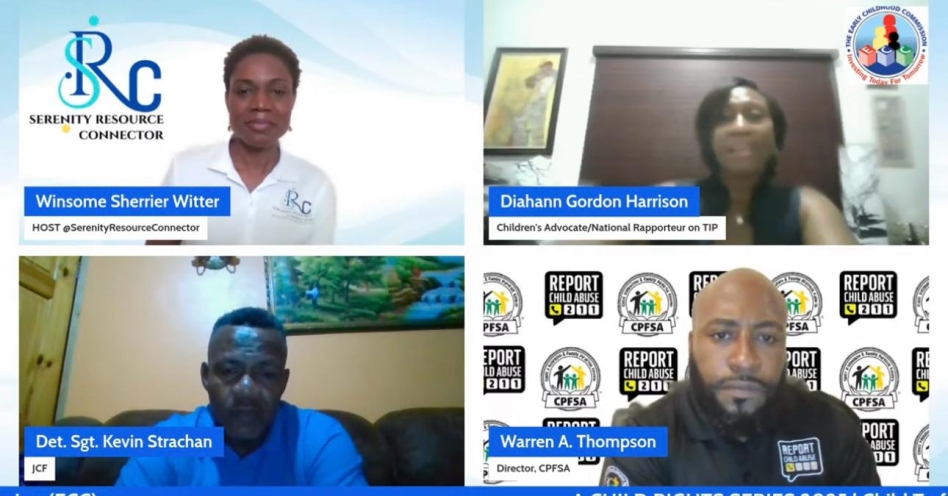
A screenshot of the Serenity Resource Connector’s (SRC) Child Rights YouTube Series.
The stunning revelation was made by Dr. Warren Thompson, director at the Child Protection and Family Services Agency (CPFSA). In debunking some of the myths surrounding this criminal activity, the senior CPFSA official said this emerging trend involving parents is serious cause for concern. This newest discovery, he said, dispels the notion that only strangers are traffickers, while at the same time reconfirmed the long established view that majority of the perpetrators are usually individuals entrusted in care of the victims.
Dr Thompson was speaking recently on the Serenity Resource Connector’s (SRC) Child Rights YouTube Series, in collaboration with the Early Childhood Commission. The programme, hosted by community advocate Winsome Sherrier Witter, featured important voices on the frontline of child protection: chiefly children’s advocate and National Rapporteur on trafficking in persons (TIP), Diahann Gordon Harrison; and Detective Sergeant Kevin Strachan of the Jamaica Constabulary Force (JCF).
The sobering discussion delved deep into the realities, misconceptions and legal framework surrounding child trafficking in Jamaica, while highlighting the crucial role of the community.
Defining Child Trafficking in Jamaica
Gordon Harrison opened the discussion by grounding viewers in a clear legal and practical understanding of child trafficking. “Child trafficking is simply the human trafficking of someone below 18 years old,” she explained. “It involves recruiting, transporting, transferring, or harbouring a child for the purpose of exploitation.” She emphasized that, unlike adult cases, there is no need to prove coercion or deception in child trafficking because children cannot consent to their own exploitation.
Importantly, she dispelled the common belief that movement is always involved in trafficking. “A child can be exploited right in their own home. They don't have to be moved to another location. So child trafficking is really the exploitation of a child for the benefit of another person… movement may not be involved,” she stated.
According to Gordon Harrison, in Jamaica, the most prevalent forms of child trafficking are sexual exploitation and forced labor, including domestic servitude.
On the Ground Reality
Detective Sergeant Strachan added that while Jamaica sees an average of four confirmed child trafficking cases per year, the number is likely under-reported due to ongoing investigations and misclassified offenses.
Dr. Thompson highlighted that many trafficked children are exploited by people they know primarily family, friends, or trusted community members, rather than strangers. He described grooming as a major method used, where gifts, attention, or affection are given with the ultimate goal of exploiting the child. “It’s not just strangers. Sometimes it’s people within the child’s circle, even parents,” he said.
Busting the Myths
Some of the most persistent myths about child trafficking are quite baffling. While some persons believe that only strangers are traffickers, many individuals are also of the flawed view that:
- It only happens to children in poor, rural areas
- It always involves sexual exploitation
- Children who appear “force ripe” cannot be victims
- Trafficking only happens across borders
Dr. Thompson added forced begging to the list of overlooked trafficking types, while Sgt. Strachan clarified the misconception around the age of consent. “Yes, the law allows consensual sex at 16, but not exploitation,” he said. “A 16-year-old cannot legally work in nightclubs or be involved in commercial sex acts.”
Root Causes and Social Media Influence
The discussion dug into the societal factors that make children vulnerable to trafficking: poverty, family dysfunction, lack of opportunity, and poor moral guidance.
“Trafficking often preys on hopelessness,” said Gordon Harrison. “Children facing abuse at home may view the trafficker as a safer option.”
Strachan noted the growing role of social media in grooming and recruitment: “We had an international case where the trafficker met the child on Facebook, even spoke with the parent, and convinced them to allow travel under false pretenses.” He stated that the internet has made it easier for traffickers to reach victims, especially during the COVID-19 era when children spent more time online.
Long-Term Effects and the Cycle of Abuse
During the discussion, Dr. Thompson emphasized the lasting trauma that trafficking inflicts on children. Many suffer from disrupted education, attachment disorders, and difficulty regulating emotions.
“Some children develop reactive attachment disorder or indiscriminate social engagement disorder,” he explained. “They either can’t form healthy relationships or form them too easily with dangerous individuals.”
A troubling reality discussed was that some victims later become perpetrators. “We’ve seen victims — especially in sex trafficking — graduate to recruiting others,” Gordon Harrison shared. “This is often due to trauma bonding and Stockholm Syndrome.”
Over the years, Jamaica has made significant progress through the Trafficking in Persons (Prevention, Suppression and Punishment) Act, the Child Pornography Prevention Act, the Sexual Offences Act, and the Child Care and Protection Act.
“The law recognizes that human trafficking is not just criminal, it’s a human rights violation,” said Gordon Harrison, referencing the Palermo Protocol, an international treaty Jamaica upholds. Still, she acknowledged room for improvement: “It’s a dynamic crime, so we must keep refining our responses.”
Community Role and Education
All panelists emphasized the importance of community action. Dr. Thompson urged every Jamaican to report suspected cases via the 211 hotline. “Don’t ignore the signs,” he pleaded.
Strachan suggested tighter partnerships between the Early Childhood Commission and national task forces, including child-friendly education initiatives and debate competitions in schools. “Reaching children early through basic schools and community groups can help prevent future exploitation,” he said.
The episode closed with a call to collective action. “We can’t stop traffickers overnight,” said Witter, “but we can stop our silence, our apathy, and our failure to act.”
This year marks two decades since Jamaica enacted its Trafficking in Persons legislation and established the National Task Force Against Trafficking in Persons (NATFATIP). In recognition of this milestone, the last week of July is observed annually as Trafficking in Persons Week, culminating on July 30, which is recognized globally as World Day Against Trafficking in Persons.